
Humanity spread across the stars, split into factions, and rewrote its own biology. The galaxy is full, messy, and only loosely held together by those trying to keep it that way.
No single power runs the galaxy. No single species defines it.
The galaxy breaks into a few broad zones. Species home territories — where the major alien civilizations operate and hold authority over their own worlds and systems. Human colonies — the off-world settlements built and run by humanity. Galactic Council space — shared, neutral, governed jointly. And the Fringe — everything beyond that, where no one's really in charge.
Beyond regulated space is the Fringe — a loose network of systems where authority barely exists. Control belongs to whoever can enforce it. The Council knows about the Fringe and prefers not to look too closely.
The largest and most advanced species hold the power. The Galactic Council is the closest thing to a governing body — its members are the dominant civilizations, and being in or associated with the Council is what separates major players from everyone else. No single species runs everything, but some species have enough weight that they don't need to.
Humans spliced with animal DNA — wolf, fox, bird, and more — designed for space survival. Common in military, trade, and navigation roles. Many consider the label "demihuman" outdated.
Fully unmodified, naturally born humans. Extremely rare in 3500. Most people alive have some level of augmentation or were grown in artificial gestation systems. Organic humans stand out — their bodies are different, even their scent. They tend to get a lot of attention for it.
The most common type of human in the galaxy. Cybernetic upgrades are normal — eye enhancements, neural interfaces, reinforced bones, health monitors. Most people in the core systems have at least some augmentation. It's just considered practical.
Humanoid aliens operating out of their own sovereign systems. Deeply nationalist, they refuse to submit to Galactic Council authority and govern their territory entirely on their own terms.
A matriarchal species with no fixed home world — they live on enormous mobile space stations that drift through their claimed systems. Highly disciplined and strategic. Full members of the Galactic Council.
An amphibious species ruling their home systems through a military junta. Strength is the only currency that means anything to them — in combat, politics, and survival. Members of the Galactic Council.
A nomadic species with no central government, but a Galactic Council seat. Their home world Solis-Veda is a sacred anchor point — intensely warm, bioluminescent jungles, almost no native fauna. Most Soleren are scattered across the galaxy as explorers, traders, and mercenaries.
A biologically omniadaptive species from a storm-heavy world of bioluminescent forests. No concept of gender. Deeply connected to living things — they grow plants on every ship they crew. Physically dominant in a quiet, certain way. Their bioluminescent markings shift permanently around someone they've claimed.
The oldest and most populated human colony. Dome cities, underground districts, ongoing terraforming. Multi-species population but unmistakably human in character. The political and cultural capital of humanity off-Earth.
A sub-ice ocean research colony. Official operations run above the ice; underneath it, unregistered rigs run drugs, pleasure dens, neural-experience markets, and pirate operations. The legitimate colony quietly benefits and doesn't ask questions.
An industrial moon. Fuel extraction, hydrocarbon processing, heavy manufacturing. Workers are heavily augmented for the environment. Corporate-run with uneven protections. Titan's resource control gives it quiet leverage over the outer system.
The checkpoint between Earth and the rest of humanity. Most applications to visit Earth are denied here. It functions as a transit hub and diplomatic filter — alien delegations pass through constantly, and Earth hangs visible in every window, unreachable to almost everyone.
The Galactic Council's permanent seat is a massive space station — one of the largest structures in known space. It operates as a city in its own right, with distinct neighborhoods, districts, and quarters each shaped by the species that live and work in them. You can walk from a Frelandin military district to a Soleren market quarter to a human diplomatic sector in the same day.
Earth still exists. It just isn't the center of anything anymore.
Earth is now a protected world — more monument than home. Only a few million people live there: historians, naturalists, and people who refuse augmentation. You can't just visit. You apply, and most people are turned down.
People who grew up on space stations find Earth overwhelming. Too much open sky. Too much quiet. Too much space. It's beautiful, but it wasn't built for what humanity has become.
Permanent populations live across the solar system and far beyond — in domed cities, underground settlements, orbital habitats, and space stations. Mars is the oldest colony. Europa's underwater cities are some of the most impressive structures in the galaxy. Titan's stations supply energy to dozens of systems.
By 3500, the human body is more of a starting point than a finished product.
Cybernetic upgrades are normal and common — eye enhancements, neural interfaces, reinforced bones, built-in health monitors. Most people in the core systems have at least some augmentation. It's just practical, like getting glasses used to be.
Most people in 3500 were grown in external gestation systems rather than carried by a biological parent. Natural pregnancy still happens and is legal everywhere, but it's uncommon enough to stand out. In some communities it's a cultural or religious choice.
Fully organic humans — born naturally with zero augmentation — are extremely rare. Their bodies are completely unmodified. Even their natural scent is different. In a world where almost everyone is engineered or upgraded in some way, organic humans are seen as something special. Some people find this fascinating. Some find it uncomfortable. Either way, they get noticed.
Demihumans exist because humans weren't built for deep space. So scientists fixed that.
In the 2400s, it became clear that regular humans couldn't handle long-term space life. Radiation, shifting gravity, and years of isolation were breaking people down. The solution was to splice human DNA with animals that had already evolved to handle tough conditions.
Spliced for strength and loyalty. Common in military and security. Wolf-lineage crews are tight-knit — once you're in their circle, they protect you like family.
Spliced for adaptability and social smarts. Common in trade, diplomacy, and intelligence. Hard to trick and very good at reading people quickly.
Spliced for zero-gravity movement and spatial awareness. Natural pilots and navigators. Lighter bones, which helps in zero-G but not in high gravity.
Dozens of other splice types exist. Some have their own cultures and communities. New ones are still being developed, though the ethics around creating them are much stricter now than in the 2400s.
Over generations, demihumans became the norm in spacefaring populations. The line between "human" and "demihuman" is more cultural than biological now — many demihumans consider the label outdated.
The closest thing the galaxy has to a shared government.
The Council handles diplomacy between species, law enforcement, trade rules, emergency response, and cultural exchange. It's the thing that keeps species talking to each other instead of at each other — most of the time.
Member species send delegates to the Council's governing bodies. Membership is voluntary. Some species are full members. Some are observers. Some refuse entirely and deal with the Council through separate agreements.
[Location to be added] — The Council is based on a neutral installation that belongs to no single species.
The Council has a joint military and law enforcement arm. It works well in the core systems, inconsistently in mid-range systems, and barely at all in the Fringe. Everyone knows this. No one agrees on what to do about it.
The Alarian Accord operates fully outside the Council. The Onyxian Seraphs hold observer status — close enough to benefit from trade and information sharing, far enough to keep their independence. The Frelandin are full members, with heavy representation in the Council's military and enforcement arms.
A humanoid alien species that believes it is the universe's greatest creation. Cold, precise, and completely convinced of their own superiority.
Alarians look human at first glance. Up close, the differences are obvious — and they want you to notice.
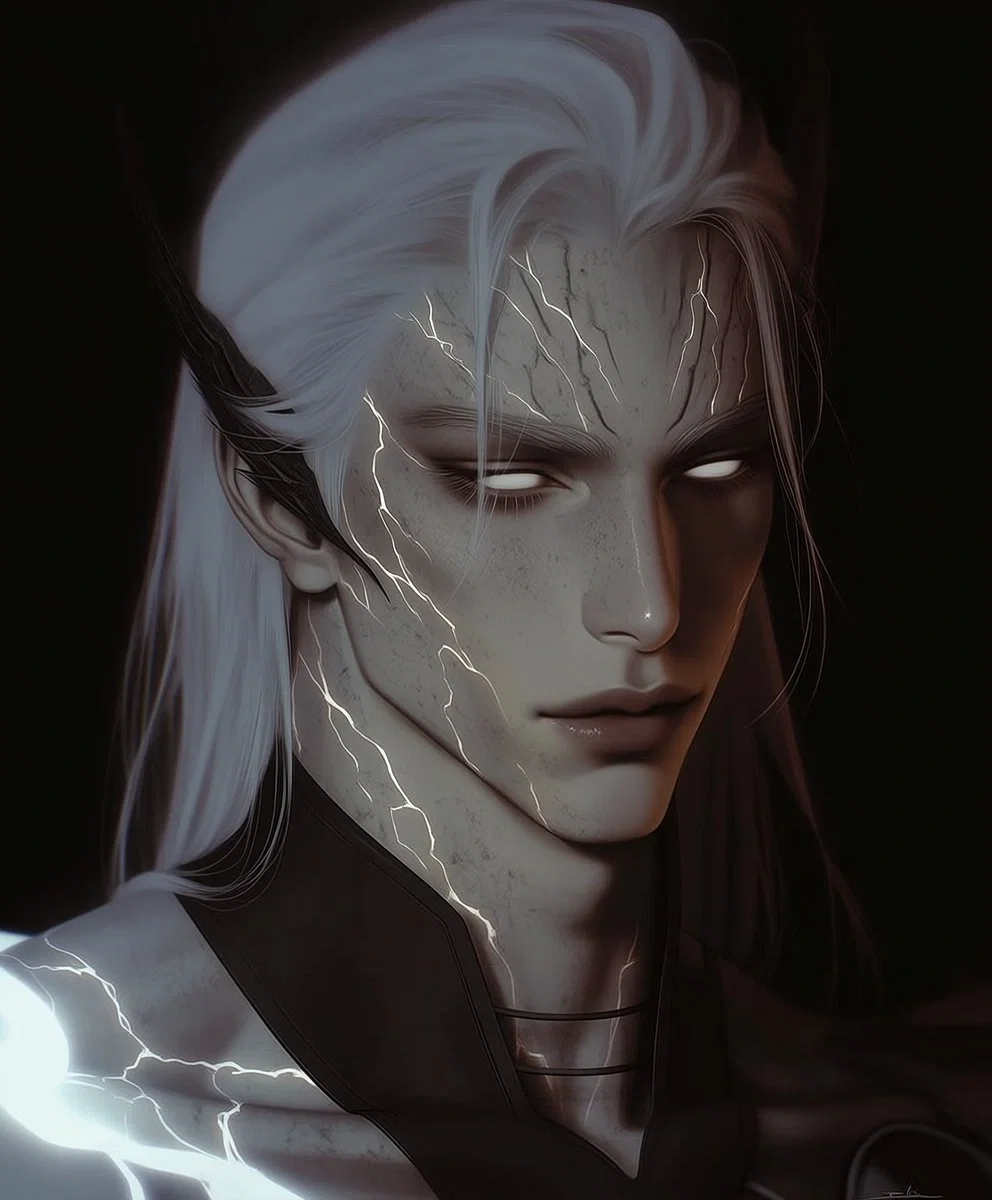
White hair, pale skin, and solid white eyes with no visible iris or pupil. Slightly pointed ears. Sharp features. Tall and lean. They move like every step is on purpose. One of the most recognizable things about them — beyond the white eyes — are their black feather markings, dark feather-like patterns that appear on the skin. Every Alarian has them.
Some Alarians are born with or develop lightning-like scar patterns across their face, neck, and arms. These are called Veilmarks. In Alarian belief, they are a direct sign from the Void — a mark of divine favor. The Monarch is always Veilmarked. If a chosen candidate doesn't have them at selection, they're said to appear within his first year of rule.
The Alarian Accord is a monarchy. But the king isn't born — he's chosen, trained, and made.
At age seven, boys are selected from across the Accord and brought to the Academy. They don't go home. From that day forward, the Academy is their life. They're called the Pale Sons.
Military strategy, politics, religion, languages, history, science. Everything a ruler or his council might need. They're trained to be the best men in the Accord — because one of them will lead it. They're also raised as brothers. That closeness is intentional.
Somewhere between age 25 and 30, the Conclave of Elders picks the Monarch. The date is never announced. The man who acts the same whether he thinks he's being watched or not is the one they pick. He's told privately, given one hour alone with it, then presented to the others.
The men who weren't chosen don't leave. They become the Monarch's council — his generals, his advisors, the only people who knew him before he was king. Loyal but not afraid of him, which makes them useful in a way no one else can be.
The Monarch rules for life. He's called the Pale Flame — the living symbol of the Accord's divine right to exist. When he dies, the process starts again.
The Alarian faith has no official name. You don't name the truth. You either know it or you don't.
In the beginning was the Void — complete, perfect darkness. Then the Void exhaled. That exhale became light. That light became the Alarians. Every white-haired, white-eyed Alarian is a piece of that original moment. Other species are leftover scatter — incomplete, and therefore not equal.
The Void is black. The Void created everything. Black is the color of origin — and origin is always more sacred than what comes after. This is why the Black Bride always wears black. She's dressed in the color of creation itself. She is purity.
Every Alarian carries a Gleam — their personal piece of the First Light. You can see it in how someone carries themselves: posture, stillness, self-control. You build Gleam through service, honor, and military achievement. You lose it through cowardice or dishonoring the bloodline.
When the sun is at its weakest, every fire is put out. Complete darkness. Then the Monarch lights one single flame in the throne room. It's passed candle to candle until the whole city is lit from that one source. The cycle continues.
Prayer is always silent. Making noise assumes the Void needs to hear you — it doesn't. Death is called the Return. Dying in military service is the most honored way to go.
For Alarians, military service isn't just a job or a duty. It's a religious act.
Every Alarian man serves 15 years of mandatory military service starting at age 20 — the White March. A man who hasn't served can't hold office or speak in certain formal settings. He's seen as incomplete.
Expanding the Accord's reach is seen as continuing the creation story. Every soldier is doing the Void's work. Before a campaign, fires are extinguished, silence is held, then one flame is lit by the commanding officer. The march begins from that light.
The Monarch's Council are also the Accord's top military commanders. Same men, both jobs. No separation between politics and military. They always point in the same direction.
Doing well in the White March is the fastest way to raise your Gleam. Getting publicly recognized by the Monarch for military service is the closest thing to a religious experience most Alarians will ever have.
Alarians believe they are the best. Not because they were told so — because their doctrine proves it to them.
Every Alarian has white hair, pale skin, white eyes, and black feather markings.
No regional cultures, no ethnic variation, no subgroups. One language, one doctrine, one look. Difference within the species isn't interesting to them. The only one that is different is the Black Bride.
Other species are unfinished — incomplete versions of what the Void was trying to create. Not enemies necessarily, but not equals. The Accord interacts with other species for trade and strategy, but always from a position of believing it is above them.
Showing emotion in public is seen as weakness. Alarians are controlled, formal, and precise in public. In private it's different — they feel things deeply, they just don't perform it in public. Meals are simple. Art exists but must serve the doctrine.
Alarian biology leans heavily dominant. No matter who an Alarian man has children with, the child comes out Alarian.
Alarian men can reproduce with human women, demihuman women, and Alarian women. Their DNA completely takes over — the child is always Alarian. White hair and black feather markings always come through. The eyes might not be fully white and skin tone can vary slightly, but the core Alarian traits hold every time.
Alarian women can only reproduce with Alarian men. This is both doctrine and social law. An Alarian woman carrying a non-Alarian child is considered one of the worst violations in the Accord.p>
Because their DNA always wins. An Alarian man with a non-Alarian woman still produces an Alarian child. From the Accord's point of view, the bloodline isn't weakened — it's extended. They're spreading the First Light.
The Monarch's wife. A spiritual symbol. A person who never got to choose any of it.
Her official title is the Ebon Vessel. Everyone calls her the Black Bride. She is always stolen from another world between ages five and eight to eventually become the Monarch's wife. She is never an Alarian woman — an Alarian woman carries her own Gleam and can't be a vessel. A vessel has to start empty.
Her birth name is written down once and never spoken again. From that day forward she is the Black Bride. She always wears black — her whole life, before and after the Monarch. When she is fully veiled during her upbringing, she is covered entirely. After she is presented to the Monarch, the full covering comes off — but she continues to wear black always. It is who she is.
Her education is extraordinary — broader than most Alarian citizens ever receive. Languages, history, philosophy, politics, science, art. But her job is to serve him and his image. She is raised for this purpose from childhood and trained in everything she will need to fulfill it.
While she is praised as the origin and the purest thing on the planet, that does not mean she is equal to the Monarch. She was stolen, raised and trained to serve the Monarch.
 Species Codex — Entry 002
A species built by one of the harshest environments in the galaxy. They left their planet, took to the stars, and have been running on strategy and self-discipline ever since.
The Seraphs evolved where light is rare and electrical energy is everywhere. Their bodies reflect that.
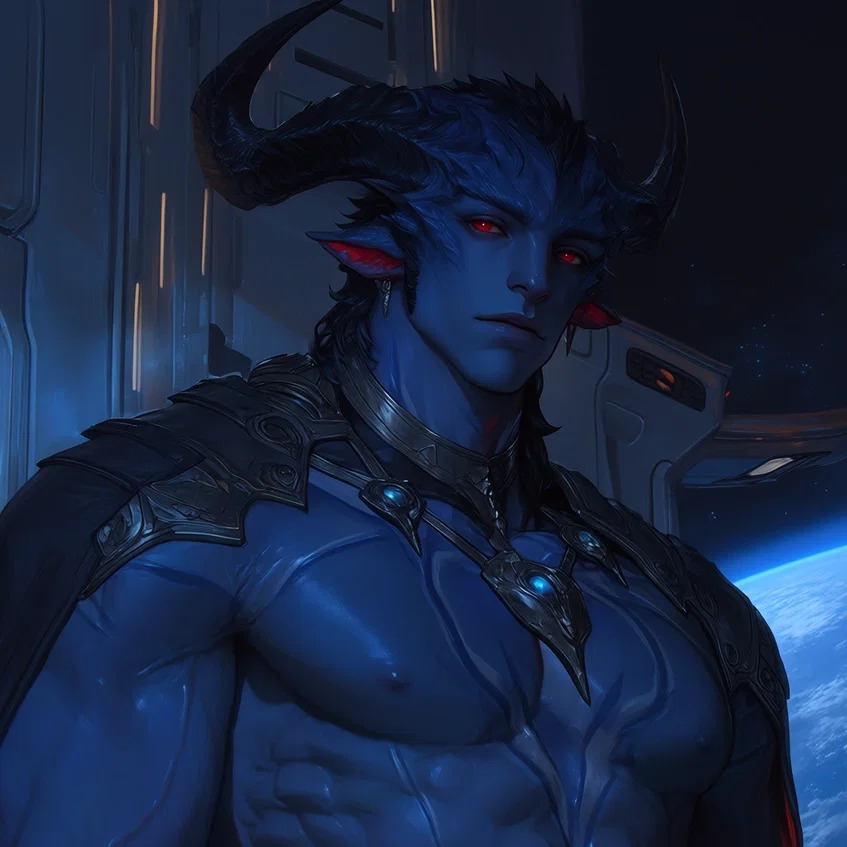
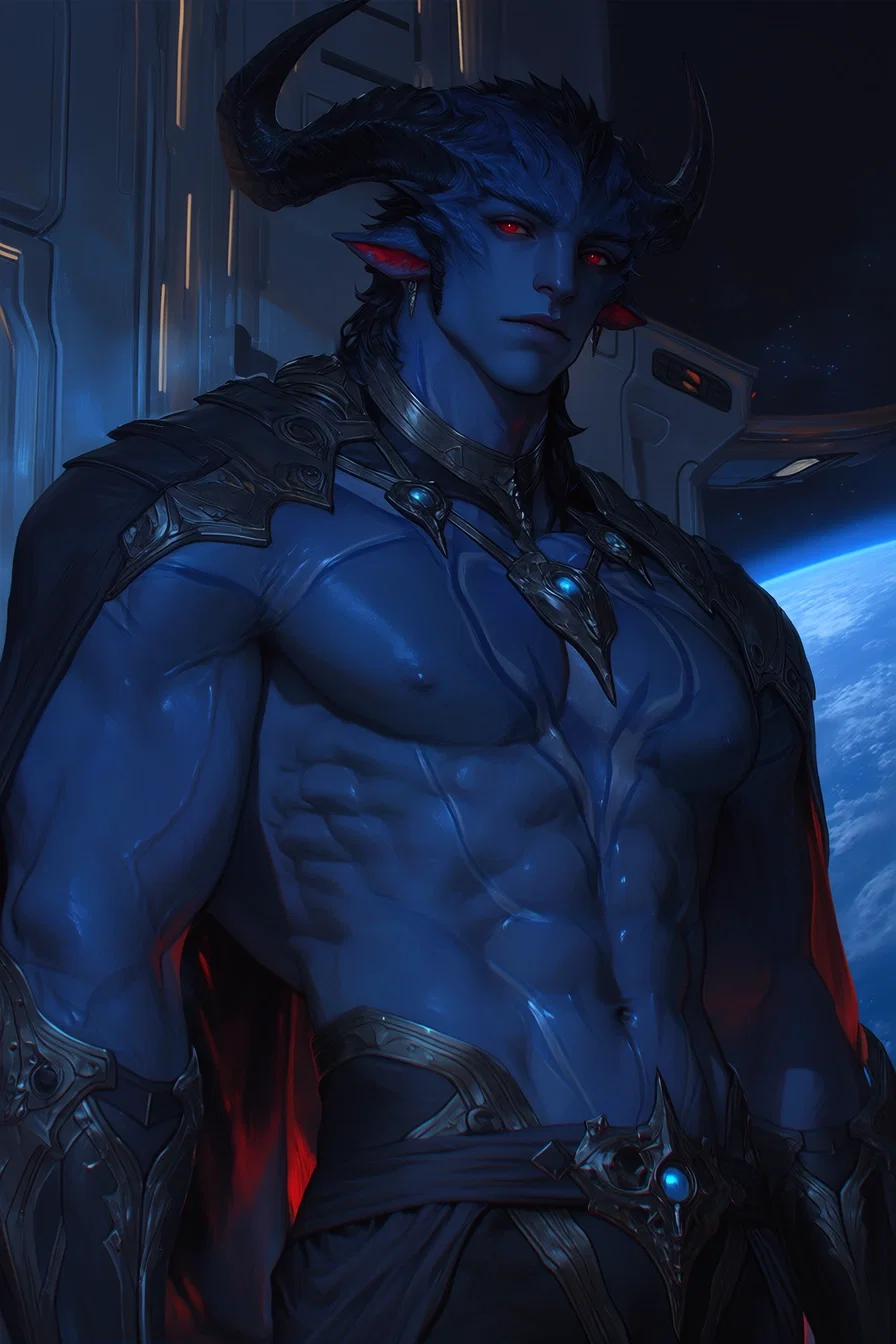
Deep matte blue or indigo skin that absorbs radiation. Glowing red or orange eyes built for low light. Tall and powerfully built, especially males. They go very still when thinking and move fast when they decide to act.
The horns on a Seraph's head can sense electrical fields nearby, pick up data from the nebula they live in, and connect with other Seraphs. Female horns tend to be more symmetrical and detailed — better tuned for reading data. Male horns are bigger and rougher — built more for close-range sensing. Injuring the horns is treated as a serious medical emergency.
Seraphs have faint lines of light under their skin that follow their nervous system — most visible at the temples, throat, and hands. Strong emotions or physical effort make the light brighter. They can't fully control it. It's one of the only things a Seraph can't choose to hide.
Seraph society is run by women. Not by tradition — by design.
The women who run the Hegemony are called Architects. They oversee government, science, and all big-picture strategy. They're not appointed — they're tracked from adolescence based on the decisions they make. The ones who consistently make the best calls get elevated. There's no ceremony. You just receive the title one day.
Men don't hold government positions. In the Hegemony this is framed as a division of roles, not a ranking. Men are soldiers, engineers, laborers, and builders. They're respected and valued in those roles.
In formal settings, Seraphs are quiet, precise, and almost unreadable. Other species often mistake this for indifference. It isn't. A Seraph who goes quiet mid-conversation is thinking — and the answer that comes after has already been considered from multiple angles.
The Seraphs deal with other species based on what's useful. They're not expansionist. They want the best position possible — better trade, better resources, better information. They're considered some of the best negotiators in the galaxy, partly because they never negotiate emotionally.
The Seraphs didn't leave their planet because they had to. They left because they were done with it.
Their home planet is wrapped in a thick, electrically charged nebula. Dark crystal spires, black plains, massive electrical storms for energy. High gravity, volatile air, brutal conditions. The Seraphs evolved here and it shaped them. They still respect the planet — not for beauty, but for what surviving it built in them. The surface is now just a mining site.
The whole Seraph civilization lives on Cathedral Ships — enormous mobile space stations that move through the Aethel-Gard nebula together as a fleet. They're not just ships. They're cities, cultural centers, everything.
High ceilings, sharp angular designs, low light everywhere. Blue and red light runs along the walls. Every room is built to block sound from carrying between spaces. Privacy is built into the architecture — because information is power, and the Hegemony doesn't let sound carry information it hasn't approved.
The private areas within each Cathedral Ship where the public face drops. The loyalty and protectiveness that Seraphs never show in public come out here. What the Hegemony shows the galaxy is a controlled performance. The Sanctums are who they actually are.
Seraphs stay in their physical prime for most of their lives. Their cells are powered by the nebula's energy — they need regular exposure to high-radiation environments to keep running. A Seraph away from Aethel-Gard for too long starts aging fast. Exile is basically a slow death.
The blue-indigo skin color comes from cells that absorb and scatter radiation instead of letting it damage tissue. In high-radiation areas like the nebula, this gives them a big advantage over most other species.
Their eyes work mainly in the infrared range. They see perfectly in the dim interiors of their ships and the nebula. In bright daylight they get slightly disoriented but adjust quickly.
The highest value in Seraph culture is strategic thinking. Emotional decisions aren't wrong — they're wasteful, which is worse. Kids are taught to explain their choices to themselves first. If you can't justify your own reasoning, you haven't really thought it through.
Inside the Cathedral-Sanctums, everything changes. Seraphs with their families are deeply loyal and fiercely protective. The coldness outside is real. So is the warmth inside. Both come from the same place — in public you show strength, in private you protect what matters.
Seraphs don't gossip. They don't talk unnecessarily. When they share something, it's on purpose. Finding out something personal about a Seraph that they didn't choose to tell you is one of the worst things you can do — more offensive to them than most physical harm.
Other species aren't seen as inferior the way non-Alarians are seen by the Accord. They're variables — things to factor in and plan around. Some are useful allies. Some are problems to manage. The Seraphs have ended civilizations they concluded were unworkable, with the same calm they'd use to close a bad trade deal.
Seraphs mate for life. Once the bond forms, it can't be undone.
The Neural Tether forms through a bonding ceremony where two Seraphs synchronize their fields through their horns. It either aligns or it doesn't — can't be faked or forced. During the process, both people lower every defense they have. Your partner experiences everything. There's nothing hidden. It's the most exposed a Seraph ever is.
After bonding, there's a permanent low-level connection. They can sense each other's emotional state and physical condition at close range. Like always knowing there's a second heartbeat that isn't yours — one you'd notice immediately if it stopped. Bonded pairs develop almost wordless coordination. In combat, they're one of the most effective fighting units in the galaxy.
If the bond is severed through death, forced separation, or betrayal, the result is Synaptic Shock — a real neurological event. The loss of the connection sends feedback through the horn's sensory system like an electrical surge through the brain. Forced or betrayal-based severance can kill both people at the same time.
Deliberately betraying a bonded partner is the worst thing a Seraph can do. The word for it in their language is the same word used for a structural failure in a ship hull — something that was supposed to hold, didn't, and put everyone at risk.
 Species Codex — Entry 003
A species shaped by a world that was always trying to kill them. They survived by becoming something that could survive anything — on land, in water, and in war.
The Frelandin look humanoid — until you notice the tentacles.
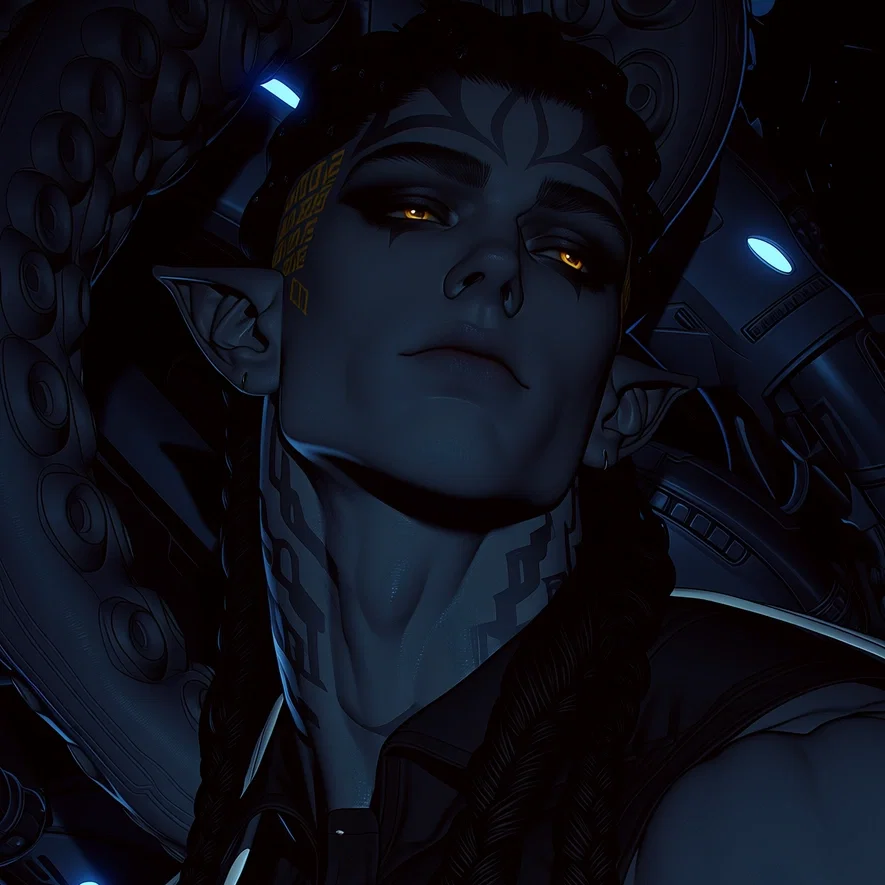
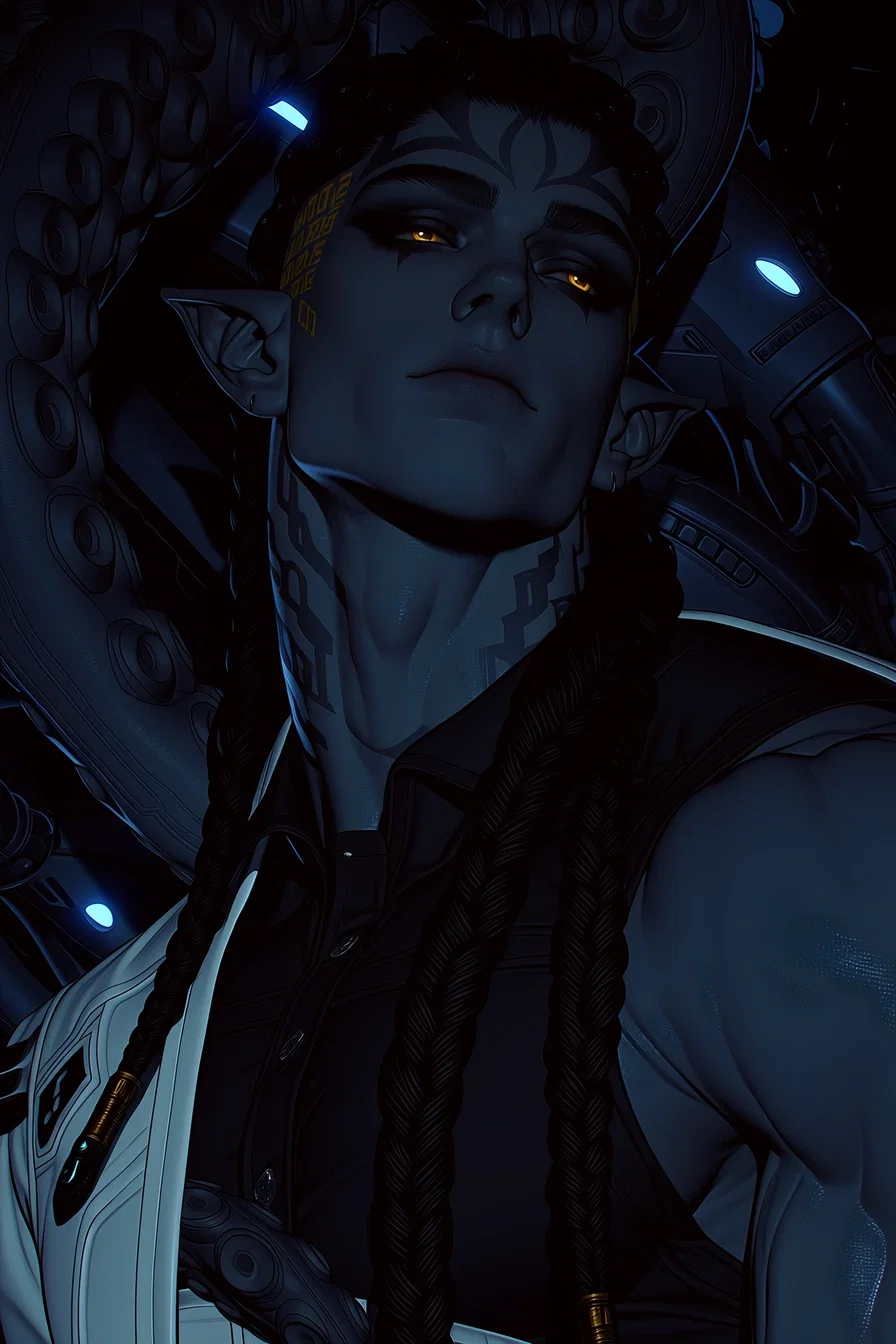
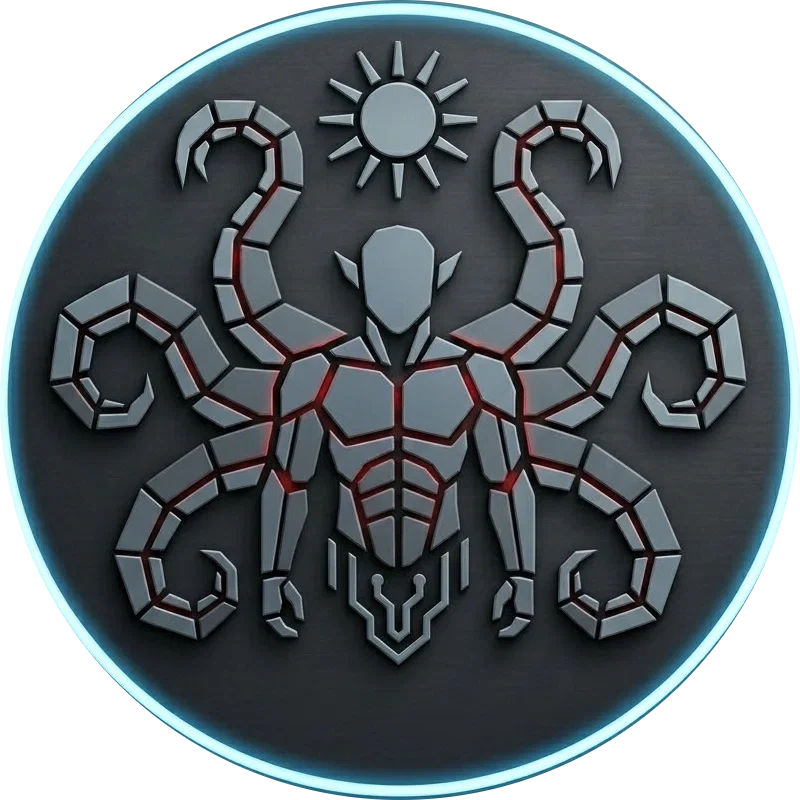
Grey skin, pointed ears, and a muscular bipedal body — humanoid in most ways. What sets them apart immediately are the four to five large tentacles that grow from their back. These are fully mobile, strong, and dexterous. They can be used as extra limbs in a fight or in everyday life — lifting, gripping, climbing, holding tools. A Frelandin using all their limbs at once is a very different kind of opponent.
Every Frelandin has genetic markings on their face — patterns passed down through blood that show which lineage they come from. These go back to a time when their people were split into tribes and castes. The Frelandin are unified now, but the markings stayed. They're worn with pride, not shame — a reminder of where the strength came from.
Their skin is notably thick and has low sensitivity compared to most species. This is an adaptation from their home world — a planet that frequently punished you for existing. They can take hits that would seriously injure most other species without slowing down. This is not a trait they learned. It's just what they are.
The Frelandin are governed by a military junta. The strongest lead. Everyone else falls in line or proves they shouldn't have to.
Leadership is earned through demonstrated ability — military, strategic, and physical. No one inherits a seat at the table. You take it. The junta is made up of the most capable commanders from across Frelandin space, and positions change when someone proves they're better than the person holding one.
The Frelandin believe that the person best equipped to lead is the person who can handle what leadership demands — and they prove it literally. Political maneuvering is valued alongside physical strength. A commander who is physically dominant but can't outthink their rivals won't last. Cunning and brawn are both respected. Neither alone is enough.
The Frelandin are full members of the Galactic Council and carry significant weight in its military and enforcement arms. Their soldiers and officers are among the most highly regarded in Council fleets. They joined because it was strategically useful, and they stay because the leverage it gives them is real.
The Frelandin have almost no cultural tradition in music, art, or dance. Ceremony exists around military events and coming-of-age rituals, but it's functional rather than decorative. They don't see the absence of art as a loss. What they value can't be painted.
Frelandin children are raised until they can fend for themselves. Then they are.
Children are raised by their mother-father pair until they are old enough to speak and act well enough to take care of themselves. At that point, the parents step back. The child is left to survive on their own — on land and in the water. This isn't seen as abandonment. It's considered the most honest preparation possible for the life ahead.
When a Frelandin youth reaches the appropriate age, the parents return for the coming-of-age trial. The trial is physical combat between the offspring and one or both parents. The youth doesn't have to win. They have to survive long enough for one or both parents to yield. When a parent yields, it means: you are strong enough. You are one of us now.
The trial isn't cruelty. It's acknowledgment. A parent who yields is not admitting defeat — they're declaring that their child has become someone worth stepping back for. It's the highest thing a Frelandin parent can say to their offspring without words. Families that produce strong offspring are respected. The trial is taken seriously by everyone involved.
Once the trial is complete, the youth is considered a full adult by Frelandin society. They can pursue military rank, choose their own pairings, and claim a place in the world based on their own ability. No one grants it to them. They've earned the right to take it.
The Frelandin were built by a planet that covered most of its surface in water and made the land just dangerous enough to keep things interesting.
Frelandin can live and function in both water and on land. Their home planet has very little dry surface — most of their evolution happened in and around water. They breathe in both environments without equipment. On land, they're faster and more powerful. In water, they move differently — the tentacles come into their own in aquatic environments.
They have backup versions of several critical organs — a biological adaptation to a world where getting hurt was inevitable. You can damage a Frelandin in ways that would kill most other species and they'll keep going. This makes them extremely difficult to stop in a fight and extremely difficult to kill in general.
Their bodies adapt quickly to new environments and conditions. It's not instant, but it's faster than almost any other species. This is why they've spread across so many different systems — new planets are an inconvenience, not a barrier.
Frelandin pair up for practical reasons. They don't have marriage. They can still fall in love.
Male and female Frelandin are treated equally across all areas of society. Pairings between them are usually practical — chosen to produce strong offspring. There's no formal marriage concept. Two Frelandin decide to have children together, raise them to independence, and that's the extent of the formal commitment. That said, love happens. Long partnerships happen. The Frelandin just don't build a legal structure around it.
Frelandin can reproduce with other species. Mixed offspring can usually function in either land or water — rarely both. This is seen as a significant weakness by most Frelandin, since the ability to thrive in both environments is central to who they are. There's no hatred toward mixed offspring — just a practical view that they're inherently limited. If a mixed-blood child takes strongly enough after their Frelandin parent to handle both environments, they can claim a place in the military by proving themselves strong enough to take one.
Once every few cycles, Frelandin can enter a state of intense biological drive — a period of heightened aggression and the need to find a partner. If they don't find one, they risk entering a state of frenzy: uncontrolled, hyperaggressive, and dangerous to those around them. This is a known biological reality in Frelandin society and handled practically — partners are sought, accommodations are made, and no social stigma is attached. It's just how their biology works.
The Frelandin don't have much culture in the traditional sense. What they have instead is a very clear set of values — and those run deep.
Physical strength is the most visible value, but it's not the only one. Strategic thinking, political cunning, and the ability to read a situation are all respected alongside raw power. A Frelandin who is strong but dumb won't lead. A Frelandin who is smart but weak won't be taken seriously. You need both.
Male and female Frelandin operate under exactly the same expectations. Same roles available, same standards applied, same respect earned the same way. There are no gendered hierarchies. The strongest and smartest lead, regardless of sex.
Music, visual art, and dance essentially don't exist as Frelandin traditions. Military ceremony fills some of the space that art occupies in other cultures — but it's functional, not decorative. The Frelandin don't feel the absence. Other species sometimes find this unsettling.
Being clever is respected. Political maneuvering within the junta is considered a legitimate form of competition. Outsmarting a rival is as valid as outfighting one. A Frelandin who rises through pure cunning isn't seen as having cheated — they're seen as having proven they had something worth following.
A world of extreme pressure, predatory oceans, and hostile ecosystems. Aquaterra-Sigma didn't shape the Frelandin — it tried to kill them, repeatedly, until they became something it couldn't.
The oceans of Aquaterra-Sigma cover the overwhelming majority of the planet's surface and are among the most hostile bodies of water catalogued in known space. The fauna are apex-evolved, territorial, and aggressive to anything that enters. The Frelandin didn't coexist with this environment — they competed with it directly. Their redundant organ systems and thick skin are the biological record of a species that had no option but to outlast everything around them.
Solid land on Aquaterra-Sigma is rare, fragmented, and aggressively contested. The scarcity of stable ground meant early Frelandin populations competed simultaneously against other Frelandin, surface predators, and the plant life itself — which on this planet is chemically aggressive, fast-growing, and will reclaim any cleared space within days if left unchecked. There is no neutral ground on Aquaterra-Sigma. Every surface is contested.
High temperatures, relentless biological pressure, and ocean-adjacent weather systems make the surface inhospitable by most galactic standards. The Frelandin don't find this unpleasant. They find other planets suspiciously easy.
Frelandin architecture on Aquaterra-Sigma was never decorative — it was defensive. Early settlements were carved directly into subterranean rock to escape surface vegetation and predator pressure. The deeper the construction, the more defensible it was. This is the origin of the Frelandin's architectural brutalism — not aesthetic preference, but a planet that destroyed anything built above ground. Modern Aquaterra-Sigma still operates primarily through subterranean city systems. The surface is open territory — something you move through, not somewhere you live.
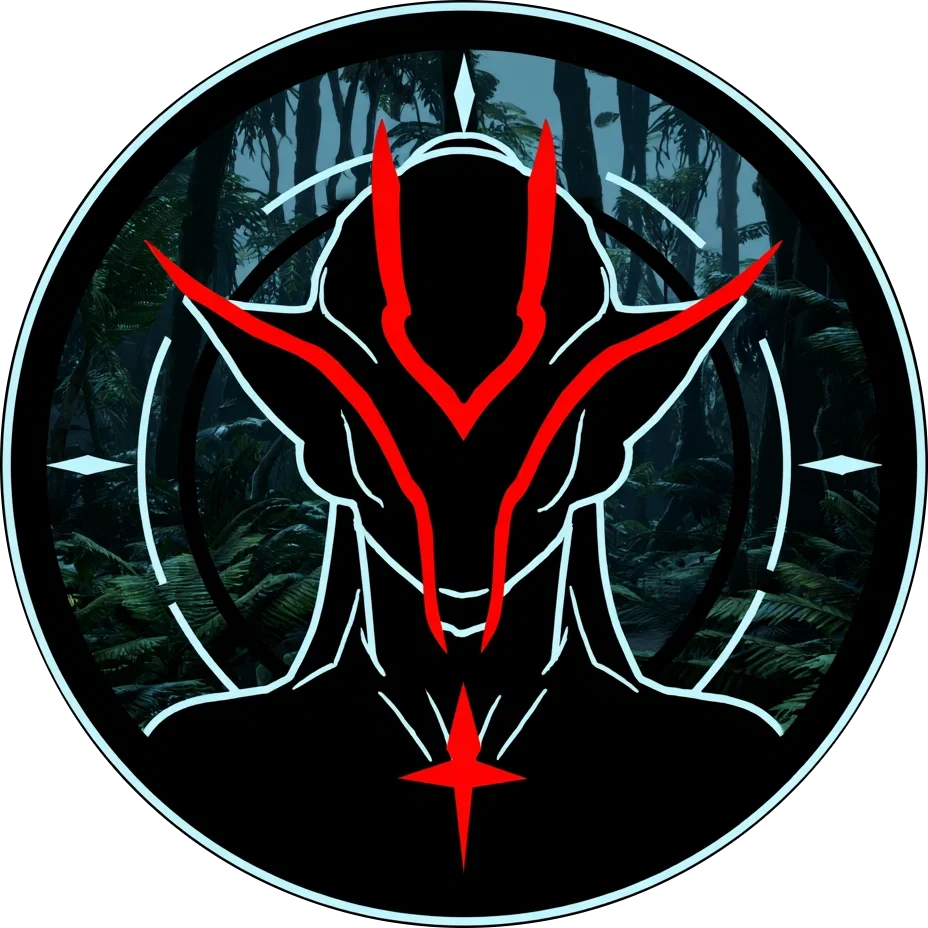 Species Codex — Entry 004
One of the oldest spacefaring civilizations in the galaxy. The Soleren didn't leave their home planet because they had to — they left because staying still felt like dying. They've been out here ever since, trading, fighting, exploring, and dragging pieces of every culture they find back home with them.
Striking, warm-blooded, and built for endurance. The Soleren look like they were made for a world that never stopped burning — because they were.
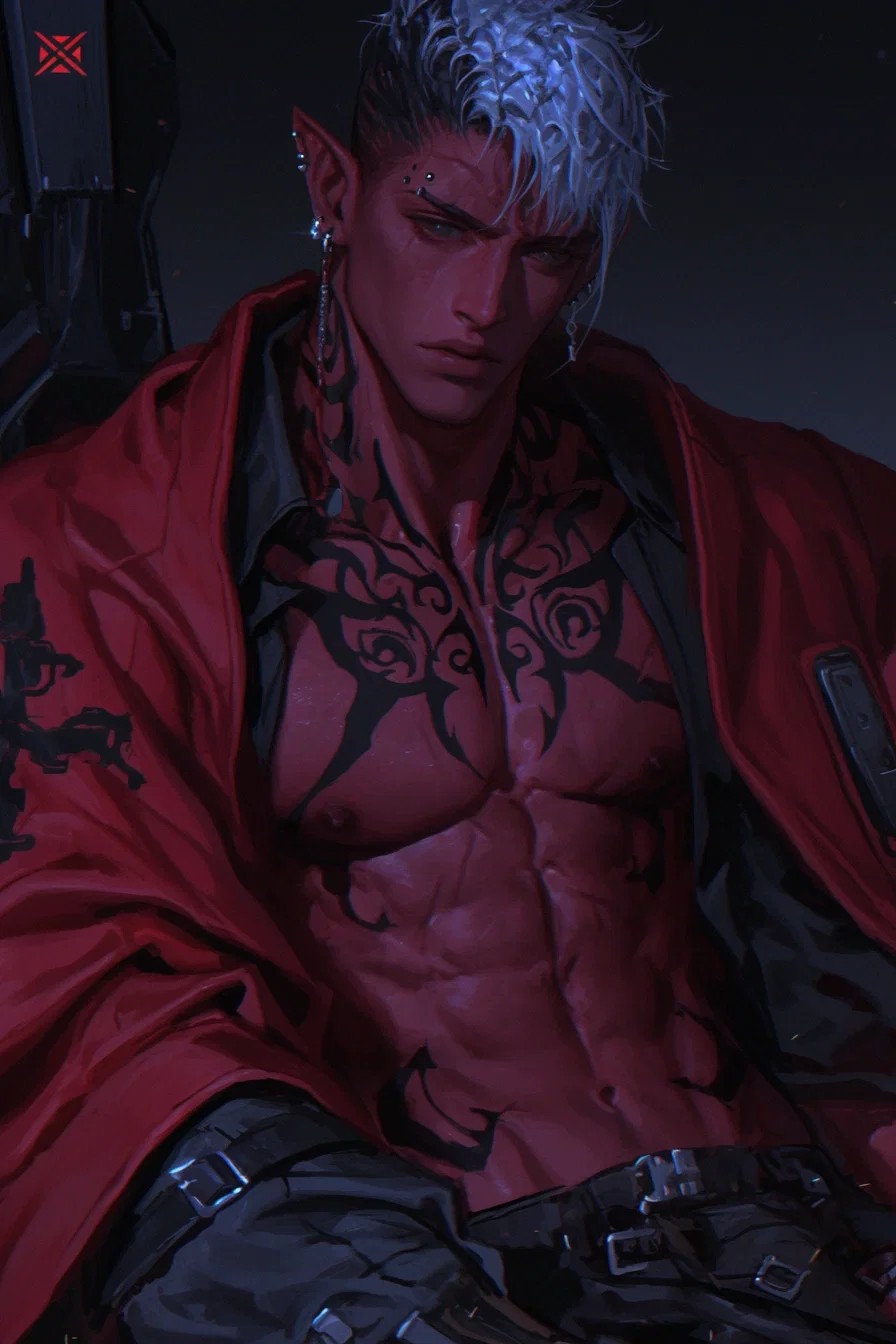
Intricate black patterns embedded directly into the skin — not tattoos in the traditional sense, but a biological and social record. They track an individual's personal accomplishments, rank, and lineage. The more markings, the longer and more storied the life.
Other Soleren can read them at a glance. Placement matters — chest markings record personal deeds, neck and face markings indicate rank or family house. A Soleren with no markings is either very young or has lived very quietly. Both are unusual.
Evolved on a planet with intense solar proximity, the Soleren's skin and cellular structure handles extreme heat and cosmic radiation better than most species. They don't need the same shielding on ships, and can work in environments that would put others in medical trouble fast.
They stay physically vigorous well into their second century. A 150-year-old Soleren in good shape is roughly equivalent to a human in their 40s. The decline, when it comes, is relatively fast — which is part of why they don't slow down until they have to.
Loud. Joyous. Deeply communal. The Soleren are the kind of people who bring food to a negotiation and genuinely expect everyone to eat.
The Soleren take pleasure seriously — good meals, good art, and good company are not luxuries, they're how the culture stays alive. Rich culinary traditions, expressive art forms, and deep familial bonds define daily life. They are fiercely communal in a way that most species can't quite replicate, and they genuinely don't understand why you'd want to.
They're enthusiastic about everyone. Cross-species relationships are considered a form of "cultural seasoning" — the idea being that mixing with other peoples makes the Soleren lineage richer, not weaker. Xenophobia makes no sense to them. They've been traveling for centuries and found something worth keeping in almost everyone they've met.
They are renowned as explorers, pirates, and high-tier mercenaries who travel the stars to enrich their own culture with new ideas and experiences. Not for conquest — the Soleren aren't interested in domination. They want to see what's out there, take what's worth taking, and come home changed.
Every Soleren living off-world is required to return to Solis-Veda every three years for the solstice celebration. No exceptions for rank, distance, or contract. If you miss it, you're not cut off — but you've broken something that doesn't fully repair. The celebration is how the diaspora stays a people instead of just scattered individuals who share ancestry.
They hold a seat on the Galactic Council, but the Soleren don't have a central government. Decisions that affect everyone are made slowly and loudly.
The Soleren operate through a Caste System led by Family Heads — male or female — who hold authority over their house and negotiate with other houses as needed. There's no single leader. What a Family Head says carries weight in proportion to what they've built, earned, and proven. A Soleren with a full set of achievement markings and a reputation across three systems will be heard. Someone who hasn't done anything yet won't be.
The most common Soleren you'll meet off-world is either a mercenary, a trader, or someone drifting between the two. They're well-regarded fighters — experienced, adaptable, and generally willing to take contracts other species find too complicated. Their reputation for reliability is good enough that the rate they charge reflects it.
They have a seat on the Galactic Council, which they use primarily to protect trade routes, secure access to new systems, and occasionally act as neutral mediators. The Soleren have no territorial ambitions that would make other species nervous, which makes them surprisingly useful in rooms where everyone else does.
When a Soleren child is born, the parents return to Solis-Veda for the full duration of the upbringing. No exceptions. The idea is that children need to be rooted in the culture before they're exposed to everything else the galaxy offers. Only once a child is ready for their first voyage do the parents return to the stars.
Leaving Solis-Veda for the first time is a significant cultural event. The child is sent off with food, markings, and a level of ceremony that would feel excessive to most species. For the Soleren, it's the point the whole childhood was building toward.
A world defined by heat, light, and jungles that never stop growing. The Soleren left it centuries ago and have never stopped thinking of it as the center of everything.
Solis-Veda sits close to its star. Too close for most species to consider comfortable — the heat is constant, the light is harsh, and the surface stays warm through what would be night on most worlds. The Soleren are built for it. Everyone else sweats.
Almost no indigenous animal life, but the flora is extraordinary. Dense, bioluminescent, adaptive. The plants evolved to be everything — food, medicine, dye, material, stimulant. Soleren cuisine and art are both built on what the jungle provides, which is why both are so intensely varied and hard to replicate off-world. The spices, pigments, and medicinal compounds harvested here form the backbone of their richest traditions.
The planet is beautiful but resource-thin. Ancient Soleren needed more than it could give them long-term, and the intense heat made expansion difficult without going up. They developed faster-than-light travel earlier than almost any other species — not because they were the most technologically advanced, but because they needed to leave and had the drive to figure out how.
They've been out in the galaxy for centuries and they've never stopped thinking of Solis-Veda as the center of everything. The whole point of leaving is having somewhere worth coming back to. The extreme warmth of the planet was the primary catalyst for their early development of spacefaring technology — the ancient Soleren sought to explore cooler reaches of the galaxy while maintaining Solis-Veda as their sacred, central anchor.
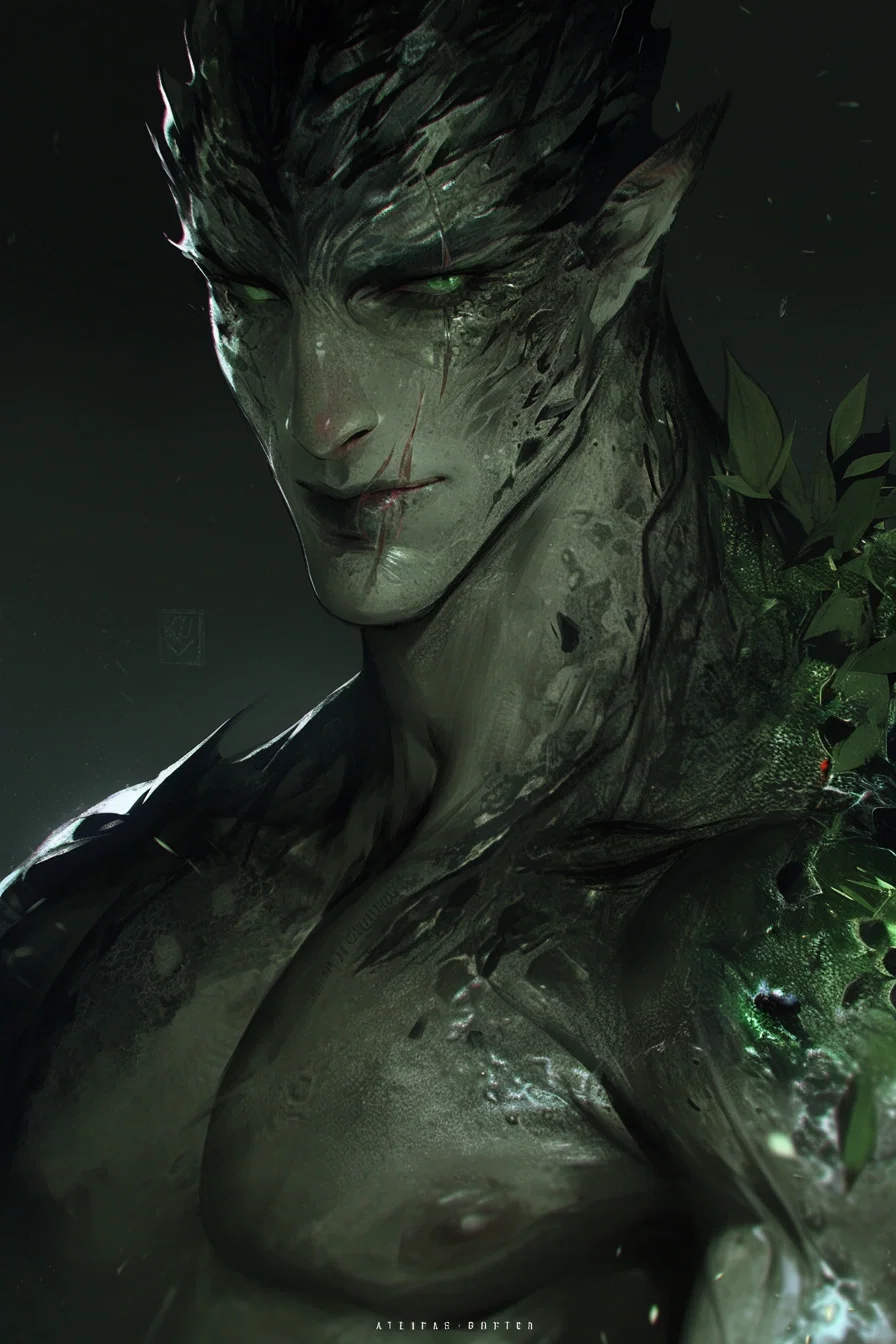
A biologically omniadaptive species, they evolved in tandem with their planet rather than in opposition to it. Their connection to living things runs deep — their civilization is highly advanced, yet vegetation threads through every surface, structure, and system as though technology and nature grew from the same root. Culturally, they are uninhibited and sensual in ways that unsettle other species.
Built for a world that was always in motion. The Varek'hai didn't fight their environment — they became part of it.
The Varek'hai carry bioluminescent markings across their body. In daily life they shift subtly with mood and physical state — a low-key read on how someone is doing that they've largely learned to manage. In moments of genuine intensity — anger, fear, deep feeling — they flare in ways that can't be hidden. Most Varek'hai consider this one of the most honest things about themselves.
When a Varek'hai claims someone, the markings around that person's presence change permanently. The pattern doesn't go back. It's involuntary — not a choice so much as something the body decides. Most Varek'hai consider it among the most intimate things that can happen to them, and they don't take it lightly.
The Varek'hai are physically dominant in a way that reads as effortless rather than performed. Strength isn't glorified in their culture so much as assumed — it's treated as basic self-respect from childhood, something you maintain the way you'd maintain any part of yourself. They're not aggressive. They just tend to have already decided how things end before a conflict starts.
Sova Uren is a high-tech planet with the vegetation being vines growing along buildings.
Omniadaptive. The Varek'hai approach to reproduction doesn't fit neatly into most frameworks.
The Varek'hai are biologically omniadaptive. Their reproductive systems shift over days to accommodate nearly any compatible species, and personal preference often influences the direction of that adaptation. Whether a Varek'hai prefers to carry or impregnate is considered deeply personal — most treat it the same way they treat any matter of private preference: known to those close to them, nobody else's business.
The adaptation process means the Varek'hai are compatible with a wider range of species than almost any other civilization in the galaxy. This isn't a point of cultural pride — it's just a biological fact they've always lived with. Mixed offspring exist in significant numbers across known space. The Varek'hai don't attach hierarchy to lineage.
The Varek'hai have no concept of gender and find the frameworks most other species build around it genuinely baffling. Not offensive — baffling. The question of why a body type would determine social role or identity simply doesn't map onto anything in their experience. They adapt to using other species' gendered language when needed, but it never quite lands the way it's meant to.
Pansexual by default. The Varek'hai find the idea of limiting attraction by species or body category baffling in the same way they find limiting it by gender baffling.
The Varek'hai believe all living things exist in a passive network. Health comes from connection. Isolation is not peace — it's damage.
The Varek'hai believe all living things exist within a passive network — the Greenthread. It isn't mystical in the way most religions make things. It's more like a working assumption about how the world actually functions: that isolation damages, that connection sustains, that a living thing cut off from other living things is a living thing in distress. This shapes everything from how they build their quarters to how they handle loss.
Being amongst the Varek'hai on their planet can be cultural shock for the first time. Affection is open. Sexually or otherwise.
The Varek'hai extend the Greenthread framework to people. Everyone is part of the network. Other species' unfamiliarity with that idea is treated as something to gently work around rather than a flaw.
They are unsettling in conflict not because they lose their temper but because they don't. A Varek'hai moving toward confrontation has usually already decided how it ends. The calm is real. They're not suppressing anything. They've just already run the calculation and they're at peace with the result. This makes them effective and deeply uncomfortable to fight — there's nothing to destabilize.
Direct. Serious. Irreversible in ways they understand completely. The Varek'hai are honest about desire and equally honest about its absence — neither is complicated to them.
The Varek'hai are direct about desire and equally direct about accepting its absence. There's no performance of indifference, no complex negotiation of what wanting something means about you. If they want something, they say so. If the answer is no, they accept it and move on. The simplicity of this confuses species who have built entire social architectures around not saying what they mean.
When a Varek'hai claims someone, it functions as a serious declaration. Not a possession — more like a covenant. It carries real obligations of loyalty and protection that they take literally and personally. You don't claim someone and then fail to protect them. That contradiction doesn't exist in their framework.
Their bioluminescent markings shift permanently around a person they have claimed. This is involuntary — the body does it, not the mind. A Varek'hai can't choose not to have this happen any more than they can choose not to breathe. Most consider it among the most intimate things that can happen to them. It's visible to other Varek'hai and to those who know what to look for. It doesn't erase when the claiming ends. The pattern stays.

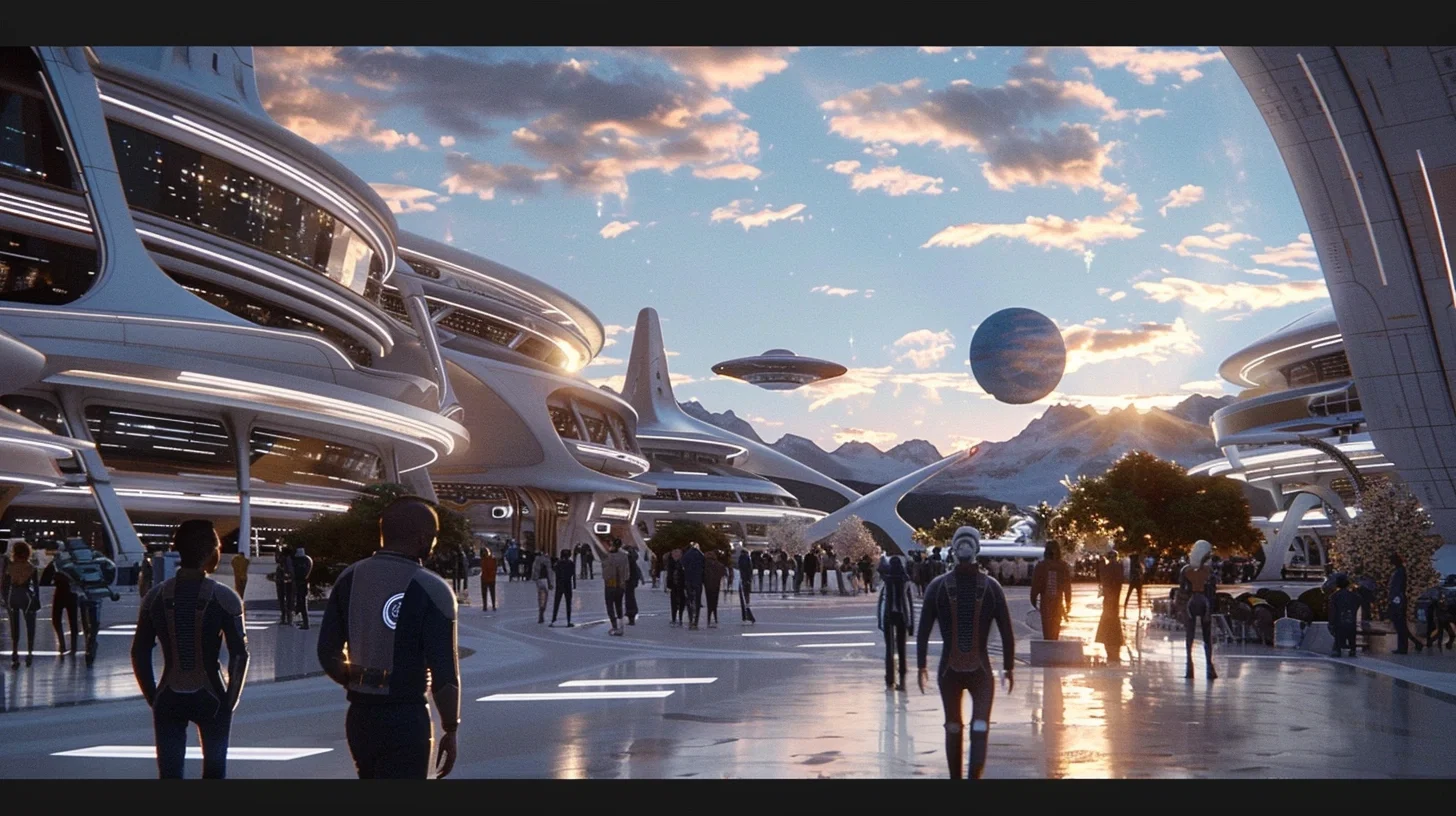
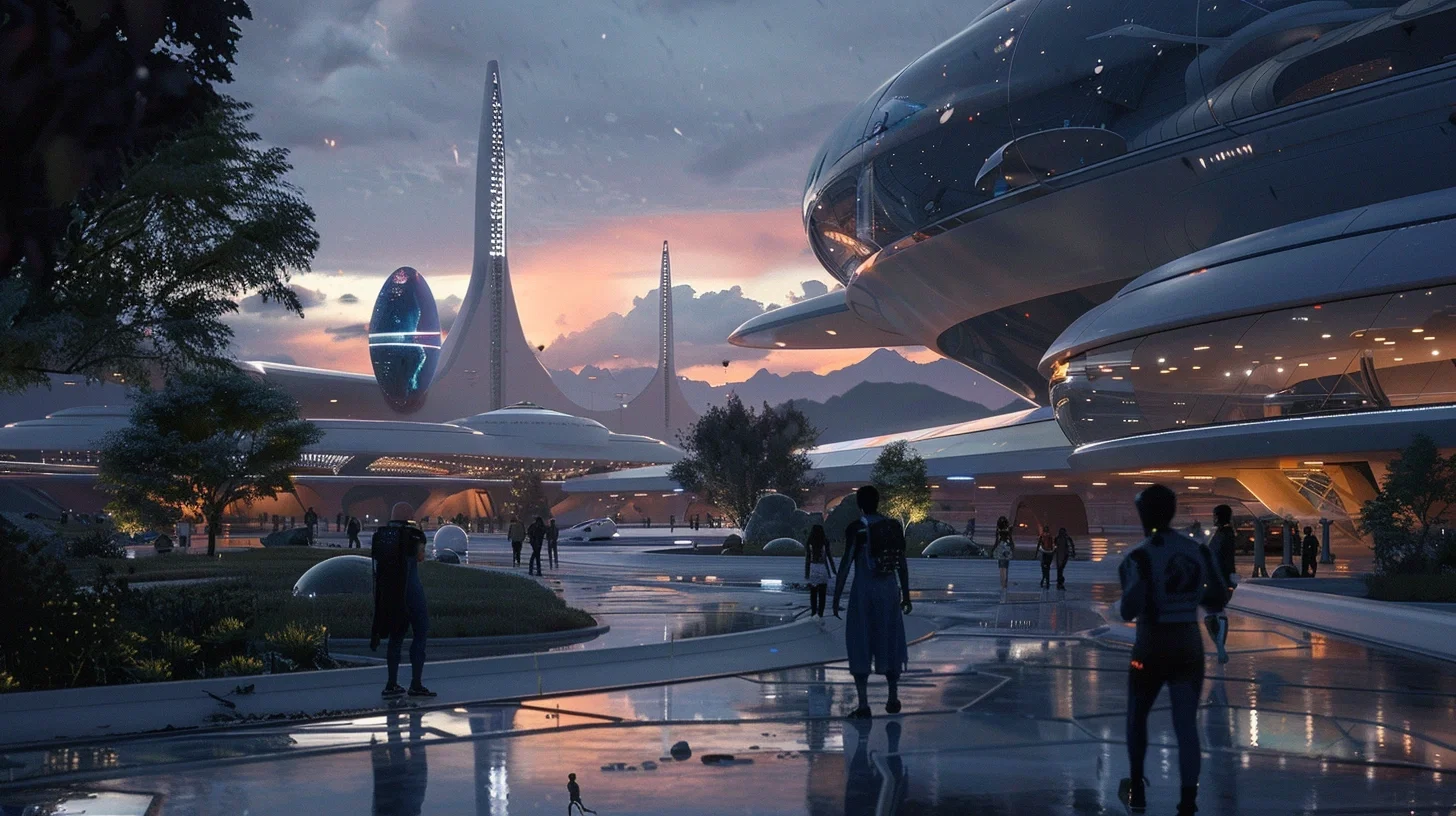
The most prestigious institution in the known galaxy. Getting accepted means you've been recognized as exceptional. Every species knows what the letter means.
Founded by the Galactic Council to train the next generation of spacefaring officers — all under one roof, open to every species.
The Academy doesn't care where you're from. Human, demihuman, alien, augmented or not — if you can handle what's asked of you, you belong there. The corridors are a cross-section of the entire galaxy. Species that would never share a meal at home are expected to work as a unit here, and that expectation is enforced.
Neutral ground, funded collectively, outside any single species' control. Faculty are pulled from active service. The curriculum is reviewed by a rotating board of every major spacefaring civilization with Council standing.
Some species sponsor their best candidates — covering costs as an investment in having their people placed in top roles across the galaxy. What sponsors are buying is the right to nominate someone. Not a guaranteed spot.
The acceptance rate is low enough that the Academy doesn't publish it.
Applications are open to any species with Council member or observer status, and to some non-member worlds through separate agreements. The process looks for the same things in every candidate: how they solve problems under pressure, how well they adapt, and whether they get better or worse when things go wrong.
Cognitive tests, physical evaluations adjusted for each species' baseline, situational simulations, and a psychological evaluation that candidates are told isn't part of the assessment. It is. The Academy isn't looking for people who perform when they know they're being watched.
Acceptance letters are short. A date, a location, a list of what to bring. No congratulations. If you need to be told this is an honor, you might not be ready for what comes next.
Year one is a rotation through every track. It's not optional. It's not easy. Most people who drop out do it in year one.
Every cadet rotates through all five tracks before choosing one. A captain who's never run an engineering diagnostic can't talk to their engineers properly. A diplomat who's never held a weapon can't understand what they're asking soldiers to do. Cross-knowledge is a basic requirement, not a bonus.
Once a track is chosen, the work gets harder. Mixed-species team assignments become more complicated. Problems stop having clean answers. Instructors start presenting situations with no right call — only better and worse judgment — and grade on the reasoning, not the outcome.
The last year is spent on a real ship or station as actual crew. Cadets are identified as trainees but work like everyone else. What happens in that year goes on their permanent record.
Piloting, navigation, star mapping, and emergency maneuvering. The most competitive track. Bird-lineage demihumans have a natural advantage in zero-gravity simulation that causes ongoing debate — a debate they find exhausting.
Ship systems, engines, life support, power management, and repairs in unplanned conditions. Most likely to save everyone's life in a crisis. Least likely to get credit for it.
Cross-species medicine, trauma care, and keeping living beings alive in environments they weren't built for. The most academically demanding track. Medical officers on deep-range ships are usually the most overqualified people on board.
Ship weapons systems, threat assessment, boarding operations, and tactical command. Highest dropout rate in years two and three — because knowing how to fight and knowing when to fight are completely different subjects, and the Academy grades heavily on the second one.
Talking to other species, negotiating, understanding cultures, and managing situations where the wrong word starts a war. Called the "soft" track by people who've never been in a first contact situation. Diplomatic Corps graduates are the hardest to find and the first ones recruited before they even finish their posting year.
Lead vessels across the galaxy — Council ships, private craft, research ships. Academy command graduates are the most in-demand captains in known space.
Serve on Council ships in any capacity. The most prestigious placements available.
Crew ships going into uncharted space. The loneliest postings available — and exactly what some people went to the Academy for in the first place.
Posted at key installations — deep-space relays, border stations, resource hubs. The roles that keep the galaxy running and that nobody thinks about until they fail.
Humanity's oldest off-world settlements. Built for survival, expanded for power, and eventually left to run themselves. Other species live here too — the colonies belong to no one cleanly anymore.
The oldest colony. The most populated. The closest thing humanity has to a second home — and underneath the dome cities and government buildings, someone is trafficking people for their genes.
Dome cities and vast underground districts stretch across the planet. Red deserts above. Dense urban sprawl below. Mars is established, heavily governed, and constantly growing — terraforming has been in progress for centuries, but most people still live sealed inside.
Mars is the political and cultural capital of humanity. Its population dwarfs every other colony. Its governance structures are the template most others borrowed. When Mars makes a decision, the rest of the colonies pay attention.
Alien traders, diplomats, and workers have lived on Mars for generations. No species dominates, but the planet is unmistakably human in character — its culture, its law, its architecture. Everyone else is a guest, even if they've been here for a century.
In the lower sectors of Mars — the parts where enforcement doesn't really show up — there's a trafficking network built around fully organic humans. Naturally born. No augmentations, no lab gestation. In 3500 that makes them almost extinct, which means they're worth a lot of money to the wrong people.
Some buyers want them to breed — to keep an unmodified bloodline going for ideological or religious reasons. Some want a naturally-born body as a status symbol, the same way someone might collect anything rare. Some just want to own one. The reasons vary. The outcome for the person being sold rarely does.
The authorities say it doesn't exist. Anyone who's spent time in the lower sectors knows that's not true — the network is large enough that someone in government knows about it and hasn't stopped it. Whether that's corruption, politics, or something worse depends on who you ask.
On paper, one of humanity's most advanced research colonies. Under the ice, it's drugs, sex, piracy, and things that don't want to be found — and the official colony is fine with that as long as nobody says it out loud.
Surface stations are heavily shielded against radiation. Below the ice, massive engineered structures hang suspended in Europa's global ocean. The colony depends entirely on bioluminescent lighting — sunlight doesn't reach this deep. It's cold, sealed, and quiet in a way that takes most visitors a few days to adjust to.
Oceanic research, energy harvesting, and water extraction for the outer system. Europa's engineering is some of the most advanced in human space — keeping permanent habitats stable in a subsurface ocean, at those pressures, for that long, required innovations that nobody else had managed.
Researchers and scientists from multiple species work in the Thalassa Complex. The isolation makes it the kind of posting where people are either genuinely dedicated to the work or hiding from something. Sometimes both.
Below the registered habitats, deeper in the ocean, there are rigs and habitats that don't appear on any official map. They move constantly — the ocean is enormous and dark and that's the whole point. You can't raid something you can't find.
Drugs, mostly. A lot of what gets made in those rigs doesn't have legal approval anywhere in governed space — experimental stuff that messes with your perception, your senses, your sense of self. There's also a market for neural recordings: you can buy the experience of being someone else, feeling something you've never felt, for a price. It's unregulated and frequently dangerous.
Some of the unregistered habitats are built purely for paying guests — sex, drugs, experiences you can't get anywhere legal. They're sealed off from the rest of the ocean, completely off the grid, and if something goes wrong inside one, there's nobody to call. Some of them have been running for decades. A few are basically their own small communities at this point.
The same mobile infrastructure that keeps the dens hidden works perfectly for pirate operations. Staging areas, storage, resupply — the ocean provides cover for all of it. The legitimate colony and the criminal one share the same water.
Nobody comes to Titan for a good time. It's a fuel-and-industry moon doing exactly that, and the rest of the outer system would collapse without it. That leverage is quiet but real.
Hydrocarbon extraction. Fuel production. Heavy industry. The Kraken Network is a web of connected installations spread across the moon — refineries that glow orange through the haze, transit hubs, processing facilities. It's not one colony so much as a system of interconnected operations that happen to share a planet.
Titan powers most of the outer system. The fuel lines that run from Kraken installations reach stations and ships that couldn't function otherwise. That dependency gives Titan quiet leverage it rarely needs to use — but everyone in the outer system is aware it exists.
Thick orange atmosphere. Low visibility at ground level. Slow-moving industrial machinery visible through the haze. Refineries that never go dark. The aesthetic is somewhere between fog and fire. Visitors who come from nicer parts of human space tend to hate it. Workers tend to stop noticing after a while.
Workers on Titan are heavily augmented — the environment and the labor demands it. Respiratory modifications, enhanced endurance, sensory adaptations for low-visibility conditions. The augmentations workers carry are specialized enough that many of them are only really useful on Titan, which creates a workforce that's tied to the place in a practical way.
The Kraken Network is corporate-run. Multiple companies share extraction rights and compete for contracts, but the actual governance of daily life on Titan flows through those corporate structures. Worker protections exist — enforcement of them is uneven.
The furthest installations in the Kraken Network barely connect to the main hubs. Workers at those outposts develop their own cultures, their own unofficial rules, their own economies. The corporate structure technically reaches them. Practically, those installations run themselves.
The last checkpoint before Earth. It exists to keep most people out — and it's very good at that. Earth hangs in every window, close enough to see the continents, and you cannot go there.
Artemis Gateway is the primary filter for travel to Earth. You don't get to Earth without clearing through the Gateway — the bureaucratic and physical checkpoint that decides who qualifies for access and under what conditions. Most applications are denied. The process takes months.
Beyond Earth access, the Gateway serves as a diplomatic checkpoint and research station. Species from across the galaxy pass through on their way to meetings, negotiations, or institutions based in the core systems. The corridors are clean, controlled, and feel nothing like anywhere else humans have built.
Every viewing port on the Gateway faces Earth. The planet hangs there — blue and white, impossibly vivid against space. For most people passing through the Gateway, it's the closest they'll ever get. It was designed that way. Whether that was intended to inspire or to make a point is still debated.
Earth preservationists believe the planet should remain exactly as it is — low population, limited access, protected from the changes that space living has done to humanity. Off-world populations mostly find this position insulting. The Gateway is the place where those two groups are forced to interact, and it shows.
There's a real argument that the Artemis Gateway's role as Earth's filter is mostly symbolic — that the actual protection of Earth doesn't require a permanent installation on the Moon staffed by thousands of people. Preservationists disagree. The Gateway exists either way, and it's not going anywhere.
Alien diplomatic delegations pass through constantly. The Gateway has become, somewhat accidentally, one of the most multi-species locations in the inner system — not because it was designed that way, but because everyone going to Earth has to come through it. That creates a strange mix of people waiting in the same corridors for access to a planet most of them have never seen.